by learnformula
search
For Business
Team license & compliance management
For Higher Education
Academic partnerships
For Government Agencies
Government training solutions
For Instructors & Course Creators
Teach on our marketplace
Become a Sponsor
Reach 9M+ professionals
Log inStart 7-Day Free TrialStart Free TrialStart Free Trial
search
Courses/Office Productivity/MS Excel

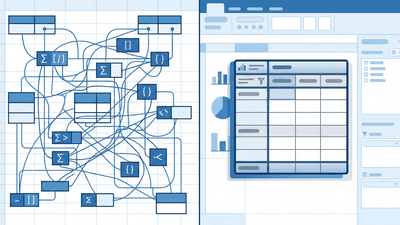
Excel University Lesson 302: Pivot Tables vs. Formulas: Choosing the Right Tool

Master the trade-offs between formula-based reporting and pivot tables to build faster, more accurate financial statements.
Created byJeff Lenningworkspace_premium
IntermediateUpdated Sep 22, 2026
Excel University Lesson 302: Pivot Tables vs. Formulas: Choosing the Right Tool

What You'll Learn

check_circleCompare the advantages and limitations of formula-based reports versus pivot tables
check_circleApply pivot table layout and design options to match specific reporting requirements
check_circleConfigure pivot table settings to handle empty cells, column widths, and grand totals
check_circleImplement multiple value fields and dynamic range references in reporting workflows
check_circleEvaluate the best reporting approach for datasets with frequent changes or missing data

About This Course

This course provides a comprehensive comparison between formula-based reporting and pivot table functionality in Excel. It examines the structural, interactive, and data-handling differences between the two methods, including how each manages new data, sorting, and reporting labels. Participants will learn how to reproduce complex formula-based reports using pivot tables, optimize pivot table settings for specific layout requirements, and implement advanced techniques like multiple value fields and dynamic sum ranges. The content focuses on selecting the most appropriate reporting tool based on specific business requirements and data structures.

Topics Covered:

  • Formula-based vs. pivot table report structures
  • Data refresh and interactivity trade-offs
  • Handling new data items and missing labels
  • Pivot table layout and design options
  • Grand total and subtotal configuration
  • Multiple value field orientation
  • Dynamic sum ranges with index and match
  • Table reference locking and range operators

Your Instructor

Jeff Lenning
Jeff Lenning

CPA and Microsoft Certified Trainer

menu_book36 courses
star1,171 reviews

In his live CPE training sessions, Jeff Lenning CPA has shown thousands of CPAs and accounting professionals across the country how to use Excel to streamline their work and become more efficient. Several publications have featured his Excel articles, including the Journal of Accountancy and California CPA Magazine. After graduating from the University of Southern California, Jeff began his career in the audit practice at Arthur Andersen’s Orange County office. He was a senior financial analyst at Gateway computers and the accounting manager at Interpore Cross International. In 2000, he founded Click Consulting Inc., a technology-consulting firm that specializes in Excel training, consulting, development, and personal coaching. He is a past president of the CalCPA OCLB Chapter, the former chair of the California CPA State Technology Committee, co-chair of the California CPA OCLB Chapter Technology Committee, a board member of the California CPA OCLB Chapter, on the California Society of CPAs Council, and an instructor for the AICPA and the California CPA Education Foundation. A Microsoft Office Certified Excel Expert, he is a nationally recognized speaker and trainer. He was recently recognized with the California CPA Education Foundation's Award for Instructor Excellence.

Credit Information

What Students Are Saying

0.0
Student's Choice
0 reviews

Frequently Asked Questions

We are a registered provider with 327+ associations and regulatory bodies worldwide. We operate across 29 global markets including Canada, the US, Australia, and the UK. Every course page clearly displays its specific accreditations. Upon completion, you receive a professional certificate that can be validated online. Our certificates include all necessary accreditation details, credit hours, and completion dates, and are formatted specifically to meet the submission requirements of most global regulatory bodies.

You May Also Like

Audit & Assurance: Fraud

AI-Enabled Fraud Investigations

star5.0(149)
2.5 CPD hrs
Audit & Assurance: Fraud

Detecting and Investigating Financial Statement Fraud

star5.0(55)
2 CPD hrs
Audit & Assurance: Fraud

Gaining the Truth: Interviewing Techniques for Fraud Examiners

star5.0(30)
1.5 CPD hrs